Copper Peptide Skincare 2026: The GHK-Cu Anti-Aging Guide Dermatologists Swear By
Copper Peptide Skincare 2026: Why GHK-Cu Is the Anti-Aging Ingredient Every Dermatologist Is Recommending
Copper peptide skincare has surged to the forefront of the beauty world in 2026, and for good reason. Known scientifically as GHK-Cu, this naturally occurring peptide-copper complex has earned endorsements from board-certified dermatologists, gained viral traction on TikTok and Reddit, and sparked a wave of new product launches from brands spanning drugstore to luxury. Unlike fleeting ingredient fads, copper peptides are backed by decades of clinical research demonstrating their ability to stimulate collagen production, accelerate wound healing, and strengthen the skin barrier from within.
As the skincare conversation shifts toward skin longevity and long-term health over quick fixes, copper peptides represent exactly the kind of science-backed, reparative ingredient that defines the new era of intelligent anti-aging. Here is everything you need to know about how GHK-Cu works, what dermatologists actually think, which products deliver results, and how to build copper peptides into your routine.
What Are Copper Peptides and How Does GHK-Cu Work?
Copper peptides are small protein fragments composed of amino acids bound to copper ions. The most studied form, GHK-Cu (glycyl-L-histidyl-L-lysine copper), is a naturally occurring compound found in human plasma, saliva, and tissues. Its concentration in the body declines significantly with age, which correlates with diminished capacity for tissue repair and regeneration.
As a carrier peptide, GHK-Cu delivers copper, a trace mineral essential for enzymatic processes involved in tissue repair and antioxidant defense. When applied topically, the peptide portion signals fibroblasts (the cells responsible for producing collagen and elastin) to ramp up activity. Simultaneously, GHK-Cu neutralizes free radicals, removes damaged collagen, and creates the conditions for new, healthy fibers to form.
"When the copper ion is delivered into skin, it signals fibroblasts to ramp up activity," explains Melanie Abeyta, a Los Angeles-based aesthetic nurse practitioner and master injector. "Copper peptides are one of the safest anti-aging ingredients we use, making them a great entry-level option for anyone new to peptides."
This dual mechanism, acting as both a cellular messenger and a repair facilitator, is what distinguishes copper peptides from simpler antioxidants or single-action ingredients. GHK-Cu does not just protect; it actively rebuilds.
Clinical Evidence: What the Research Shows
The clinical evidence supporting copper peptides has grown substantially. Research published in peer-reviewed dermatology journals demonstrates that GHK-Cu stimulates collagen and glycosaminoglycan production, improves wound healing in both laboratory and clinical settings, reduces inflammation and oxidative stress, and supports healthier skin structure over time.
In clinical trials, approximately 93% of participants showed increased skin density at week one, and 83% maintained those improvements at week four. Fine lines and wrinkles also demonstrated visible clinical improvement within the same timeframe. Perhaps most impressively, studies have shown GHK-Cu can reduce wrinkle volume by up to 55.8% while increasing skin density and thickness, a critical benefit as skin naturally thins with age.

"Copper peptides have been used in wound healing and anti-aging for years," notes Dr. Jessie Cheung, a board-certified dermatologist in Chicago. She recommends copper peptides for patients dealing with "aging, laxity, fine lines, or even acne scars," underscoring the ingredient's versatility across multiple skin concerns.
What Dermatologists Actually Think About Copper Peptides
The dermatological consensus on copper peptides in 2026 is nuanced but overwhelmingly positive. Experts describe GHK-Cu as a "supporting powerhouse" rather than a standalone miracle ingredient, which is actually a strength rather than a limitation.
"Copper peptides help stimulate collagen and elastin production, improving firmness," says Dr. Dendy Engelman, a New York City board-certified dermatologist. "They are excellent for patients wanting to strengthen their skin barrier." Dr. Harold Lancer, a celebrity dermatologist in Los Angeles, adds that copper peptides "fit the current trend toward bioactive, science-backed ingredients" that deliver gradual, sustainable results.
Dr. Alexis Granite, founder of Joonbyrd, offers a particularly thoughtful perspective: "Copper peptides are about supporting skin function, not chasing short-term results. They help reinforce the processes that naturally decline with age: repair, resilience, and structural integrity."
Dr. Jennifer Gordon, a board-certified dermatologist, provides an important caveat: while GHK-Cu is "scientifically grounded," results occur "gradually and subtly." This makes copper peptides ideal for those who understand that sustainable skin health, much like overall wellness, is built over time rather than achieved overnight. For those interested in how this philosophy is reshaping the industry, our Anti-Aging Skincare Guide 2026 covers the broader shift toward evidence-based routines.
Who Should Use Copper Peptides?
One of GHK-Cu's most compelling attributes is its broad applicability. Dermatologists recommend copper peptide skincare for several distinct groups:
THOSE SEEKING LONG-TERM SKIN HEALTH: If you are moving beyond the "quick fix" mentality and investing in skin longevity, copper peptides align perfectly with a reparative, proactive approach.
PEOPLE WITH COMPROMISED SKIN BARRIERS: Whether from overuse of harsh actives, environmental damage, or conditions like eczema, GHK-Cu supports barrier reconstruction without irritation.
RETINOID-INTOLERANT INDIVIDUALS: For those who cannot tolerate retinoids (a significant portion of the population), copper peptides offer a gentler path to collagen stimulation and cellular renewal. As we explored in our Retinol vs Bakuchiol 2026 comparison, having multiple options for anti-aging is essential.
PATIENTS WITH THINNING OR FRAGILE SKIN: As skin becomes thinner with age, copper peptides help restore density and thickness, addressing a concern that many traditional anti-aging ingredients do not adequately target.
POST-PROCEDURE RECOVERY: After microneedling, laser treatments, or chemical peels, copper peptides accelerate healing and reduce inflammation, making them a dermatologist favorite for aftercare protocols.
Best Copper Peptide Products in 2026
The market for copper peptide skincare has expanded dramatically. Here are the standout products across price points, each offering clinically meaningful concentrations of GHK-Cu:
BUDGET-FRIENDLY OPTIONS:
- Good Molecules Super Peptide Serum ($12) - An accessible entry point with a multi-peptide complex that includes copper peptides alongside supporting actives.
- The Ordinary Multi-Peptide + Copper Peptides 1% Serum ($25-32) - The cult favorite that popularized copper peptides in mainstream skincare. A lightweight, fast-absorbing formula targeting aging signs at multiple levels.
MID-RANGE PERFORMERS:
- iS Clinical Copper Firming Mist ($42) - An innovative spray format delivering antioxidant-rich copper peptides for firming and soothing throughout the day.
- iNNBEAUTY PROJECT Elastic Skin Serum ($52) - A newer entry that combines copper peptides with complementary actives for elasticity restoration.
- Medik8 Liquid Peptides ($66) - A multi-peptide formula from the respected British brand, pairing copper peptides with hydrating ingredients for comprehensive anti-aging.
- Biossance Squalane Copper Peptide Rapid Plumping Serum ($68) - Combines GHK-Cu with squalane and hyaluronic acid for hydration alongside collagen stimulation.
PREMIUM FORMULATIONS:
- NEOVA Smartskincare Night Therapy Moisturizer ($125) - A nighttime formula that leverages copper peptides during the skin's peak repair window.
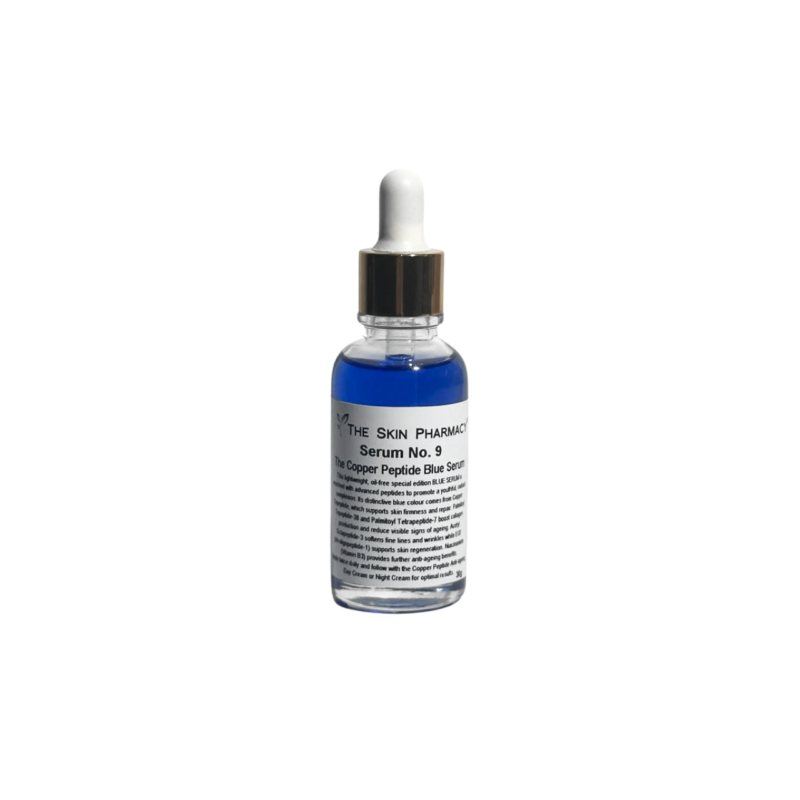
- The Skin Pharmacy Serum No. 9 "The Blue Serum" ($139.90) - A newly launched, highly concentrated GHK-Cu serum from Singapore, featuring the characteristic blue tint that comes from the copper-peptide complex itself.
- Allies of Skin Copper Tripeptide & Ectoin Advanced Repair Serum ($199) - A clinical-grade formula combining copper tripeptide with ectoin for enhanced repair and environmental protection.
How to Build Copper Peptides Into Your Routine
Incorporating GHK-Cu effectively requires understanding both application technique and ingredient compatibility. Dermatologists recommend the following approach:
APPLICATION: Apply copper peptide serums after cleansing and toning, on clean, slightly damp skin for optimal penetration. Follow with heavier creams or oils to seal in the active.
IDEAL PAIRINGS: Copper peptides layer beautifully with hydrating, barrier-supportive ingredients. Ceramides, hyaluronic acid, and niacinamide are all excellent companions that enhance rather than compete with GHK-Cu's mechanisms.
INGREDIENTS TO ALTERNATE: Exercise caution when layering copper peptides with retinoids, direct vitamin C (L-ascorbic acid), or strong exfoliating acids like glycolic acid. These combinations can destabilize the copper complex or cause irritation. The solution is simple: alternate them in your morning and evening routines, or use on different days.
FREQUENCY: Start with every other day application and build to daily use as your skin acclimates. Most formulations are gentle enough for twice-daily use once tolerance is established, but patience yields better results than aggressive introduction.
Copper Peptides vs. Other Anti-Aging Actives
Understanding where GHK-Cu fits in the broader landscape of anti-aging ingredients helps set realistic expectations:
VS. RETINOIDS: Retinoids remain the gold standard for wrinkle reduction and cell turnover. Copper peptides work differently, focusing on repair and resilience rather than forced exfoliation. They are complementary, not competing.
VS. VITAMIN C: Vitamin C excels at brightening and photoprotection. Copper peptides excel at structural repair. Together (used at different times), they cover more anti-aging ground than either alone.
VS. EXOSOMES AND PDRN: The next generation of biotech actives like exosomes and PDRN share some regenerative pathways with copper peptides but operate through different mechanisms. Copper peptides are more accessible, better studied in topical formats, and available at every price point. For a complete overview of all trending actives, visit our K-Beauty Ingredients Encyclopedia 2026.
VS. PEPTIDE BLENDS: Many multi-peptide serums include copper peptides alongside signaling peptides (like Matrixyl) and neurotransmitter peptides (like argireline). These blended formulas can be an efficient way to access copper peptide benefits within a broader peptide strategy.
Side Effects and Precautions
Copper peptides are generally well-tolerated, but awareness of potential reactions ensures the best experience:
- Rare mild irritation or temporary redness, particularly with concentrated formulas
- Tingling or sensitivity in reactive skin types
- Potential breakouts in acne-prone individuals during the initial adjustment period
- Overuse at high concentrations may paradoxically increase inflammation
A patch test is always recommended, especially for those with compromised barriers. Start with lower concentrations and build gradually.
The Market Outlook: Why Copper Peptides Are Here to Stay
The copper peptide trend in 2026 is not a fleeting moment. Several structural factors ensure its longevity in the market:
The broader shift toward skin longevity over anti-aging creates sustained demand for reparative ingredients. The ingredient's suitability for sensitive and retinoid-intolerant skin opens it to demographics previously underserved by traditional anti-aging. New delivery technologies, including encapsulation and next-generation penetration enhancers, continue to improve efficacy. And the expanding K-beauty and mediccosmetic sectors are incorporating GHK-Cu into increasingly sophisticated formulations, from cushion compacts to overnight masks.
As Dr. Lancer observes, copper peptides "stimulate collagen and elastin production" in a way that "fits the current trend toward bioactive, science-backed ingredients." In an era where consumers demand both evidence and experience, GHK-Cu delivers on both counts.
FAQ
Q: Can I use copper peptides with retinol in the same routine?
A: It is best to alternate rather than layer them simultaneously. Use copper peptides in the morning and retinol at night, or on alternating days. This prevents destabilization of the copper complex and reduces irritation risk while allowing both ingredients to work at their full potential.
Q: How long does it take to see results from copper peptide skincare?
A: Clinical studies show measurable improvements in skin density as early as one week. However, meaningful visible changes to fine lines, firmness, and overall skin quality typically emerge over four to eight weeks of consistent use. Copper peptides work gradually, building results that are sustainable rather than temporary.
Q: Are copper peptides safe for sensitive skin?
A: Yes, copper peptides are among the gentler anti-aging actives available. Dermatologists frequently recommend them for patients who cannot tolerate retinoids or strong exfoliating acids. Start with a lower concentration and patch test to confirm compatibility with your specific skin.
Q: Why do some copper peptide serums have a blue color?
A: The blue tint is natural and comes from the copper-peptide complex itself. When copper combines with the peptide GHK, the resulting compound has a distinctive blue hue. This coloring is not an additive; it is an indicator of genuine copper peptide content in the formula.
Q: What is the best concentration of copper peptides to look for?
A: Most effective formulations contain 0.5% to 1% GHK-Cu. The Ordinary, for example, offers a well-regarded 1% concentration. Higher is not necessarily better; even modest concentrations deliver clinically meaningful results when combined with proper delivery systems and supporting ingredients.
You May Also Like
- Skin Longevity 2026: Why Dermatologists Say Long-Term Skin Health Beats Anti-Aging
- Exosome Skincare 2026: K-Beauty's Biotech Anti-Aging Secret
- Retinol vs Bakuchiol 2026: Which Anti-Aging Ingredient Is Right for Your Skin?
- Niacinamide Skincare Guide 2026: Best K-Beauty Products and Routines
The Bottom Line
Copper peptide skincare in 2026 represents the maturation of an ingredient that has quietly accumulated decades of clinical evidence. GHK-Cu is not the loudest ingredient in the room, but it may be the most reliable. For those seeking genuine, science-backed skin repair, collagen stimulation, and barrier strengthening without the irritation risks of more aggressive actives, copper peptides deserve a permanent place in your routine. Start with a well-formulated serum, be patient, and let the biology do the rest.
Sources: Marie Claire | Yahoo/Women's Health | Westlake Dermatology | The Skin Pharmacy | HuffPost


댓글
댓글 쓰기